


Category: Uncategorized
Choosing the Right Autonomous Coding Vendor: A Guide for Radiology Leaders


Case Study – Maverick AI Reduces Coding Delays and Costs for SDMI
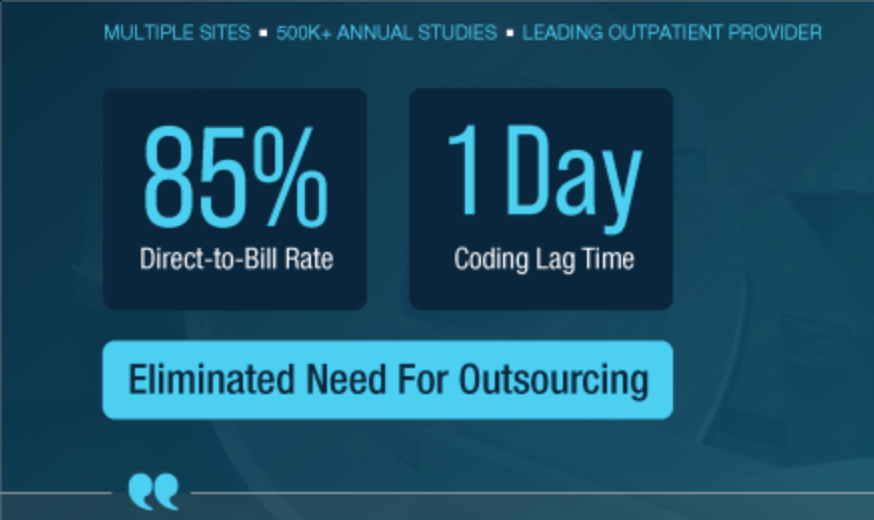

Read the Full Case Study “Maverick AI Reduces Coding Delays and Costs for SDMI”
The AI Advantage: Reclaiming Revenue and Resilience in Radiology RCM

Why CAC has consistently fallen short of expectations
How autonomous coding leverages machine learning & deep learning for accuracy, compliance, and scalability
The real-world ROI—accelerated billing cycles, reduced denials, and improved resilience for radiology RCM
The takeaway? Autonomous coding isn’t just an upgrade—it’s a fundamental shift in how we approach revenue cycle operations in radiology.
Read “The AI Advantage: Reclaiming Revenue & Resilience in Radiology RCM”
Radiology Reimagined: Maverick Sets the Standard for Autonomous Coding Success

Achieving success with autonomous coding requires more than advanced technology. Success starts with preparation. The foundation for high direct-to-bill (DTB) rates and accurate coding lies in optimizing the processes that feed the model. Every step leading up to implementation, from order entry to documentation and coding practices, influences whether the model can consistently deliver correct results without human intervention.
This blog outlines three critical areas to focus on before go-live—workflow, documentation, and coding quality—and explains how Maverick supports accuracy throughout every stage of implementation and beyond. Employing this methodology, Maverick consistently enables their customers to go live within 90 days, with over 85% of cases flowing direct-to-bill with zero human intervention, while delivering 95%+ coding accuracy.
1. Optimize Workflow for Coding Readiness.
Autonomous coding success starts well before the final radiology report. Compliance begins with the diagnostic order. Each order must include signs, symptoms, or a confirmed diagnosis per the Medicare Conditions of Participation (42 CFR 410.32)
Why it matters: Missing or incomplete order details lead to delays in coding and compliance risks. For AI models, incomplete reports mean more manual reviews, lower DTB rates and risks incorrect assumptions by the model.
Action Steps:
- Validate test orders before exams.
- Standardize ordering protocols.
- Ensure the signs, symptoms or other diagnostic information on the test order flow into the final report.Bottom line: Workflow optimization ensures the model has everything it needs to code accurately.
2. Standardize Documentation
AI engines cannot code what is not documented. Consistency across templates provides the data structure the model needs for correct CPT, HCPCS, ICD-10-CM and quality code assignment.
Ensure each report template captures the following:
- Clinical indications from the order
- Clear exam title matching the performed procedure
- Detailed technique (views, parameters, contrast)
- Substances administered (name, route, dose)
- Impression with clinically relevant findings
- Documentation for selected quality measures
Adhering to the ACR Practice Guideline for Communication of Diagnostic Imaging Findings promotes consistency and completeness, reducing ambiguity and enhancing coding accuracy whether performed manually or through automation.
3. Ensure Coding Quality
AI models learn from historical data. If that data is inconsistent or inaccurate, the model will replicate those errors at scale.
To prepare:
- Perform coding audits on a monthly or quarterly basis
- Resolve any coding issues before model training
- Standardize coding policies for consistency
- Provide ongoing education for all coders
Clean and accurate data translates to strong Direct-to-Bill (DTB) performance and reduced rework post-implementation.
Maverick’s Process for Ensuring Accuracy
At Maverick, we understand that success depends on more than just technology. Our process is built around quality oversight through implementation and beyond.
Before Go-Live: Validation Without Formal Audits
While we don’t conduct formal audits during implementation, our validation process functions as a quality
checkpoint through the following activities:
- Evaluating mismatches between model output and historical coding.
- Flagging errors in historical coding data and sharing findings with clients for correction.
- Integrating client-specific coding policies into the platform.
These activities ensure the model is aligned with both compliance standards and organizational expectations from day one.
At Go-Live: 100% Review and Daily Monitoring
During the go-live phase, Maverick and the client work together to ensure the model performs accurately
before transitioning to DTB. This stage involves intensive oversight and collaboration, including the following key steps:
- Clients review 100% of cases during week one to verify accuracy before DTB routing begins.
- Maverick’s Director of Coding Compliance monitors all coding changes made on a daily basis during this first week and provides feedback to the Maverick R&D team for any necessary model refinements.
- After week one is completed, clients determine the percentage of DTB encounters they will review for
ongoing QA. On Maverick’s end the Director of Coding Compliance will monitor all coding changes on a weekly basis and continue to provide feedback to the Maverick R&D team, as necessary. Clients also have the ability to submit support tickets for any issues they may identify during their ongoing QA.
Post-Go-Live: Quarterly Audits
In addition to client-led QA, Maverick provides an extra layer of oversight and continuous improvement through the following:
- The Director of Coding Compliance conducts quarterly audits for every client, reviewing a random
sample of DTB encounters to ensure continued accuracy. - Findings are shared with R&D as needed to support continuous improvement and maintain high coding accuracy rates.
This layered approach with pre-launch validation, intensive go-live oversight, and ongoing audits, delivers a compliant, high-performing coding solution that clients can trust.
Final Thoughts
Autonomous coding is a powerful tool delivering frictionless scalability and improving productivity, but its
success depends on careful preparation and continuous oversight. By optimizing workflows, standardizing
documentation, and ensuring high-quality historical data, providers can create an environment where
automation thrives. Additionally, Maverick’s structured approach, which combines pre-launch coding validation, hands-on monitoring during go-live, and ongoing quarterly audits, is the hallmark of a genuine partnership that drives consistent performance with high accuracy rates.
Autonomous Coding is Revolutionizing the Revenue Cycle: What Radiology Leaders Need to Know

AI is transforming radiology revenue cycles — and autonomous coding is leading the charge.
Unlike outdated CAC tools, next-gen AI now fully codes radiology reports with zero human touch, slashing turnaround time and boosting accuracy. Discover how transformer models, machine learning, and deep learning are redefining what’s possible — and why every radiology leader should be paying attention.
Read how autonomous coding is setting a new standard in healthcare.
How One Imaging Network Transformed Its Revenue Cycle with Maverick Medical AI
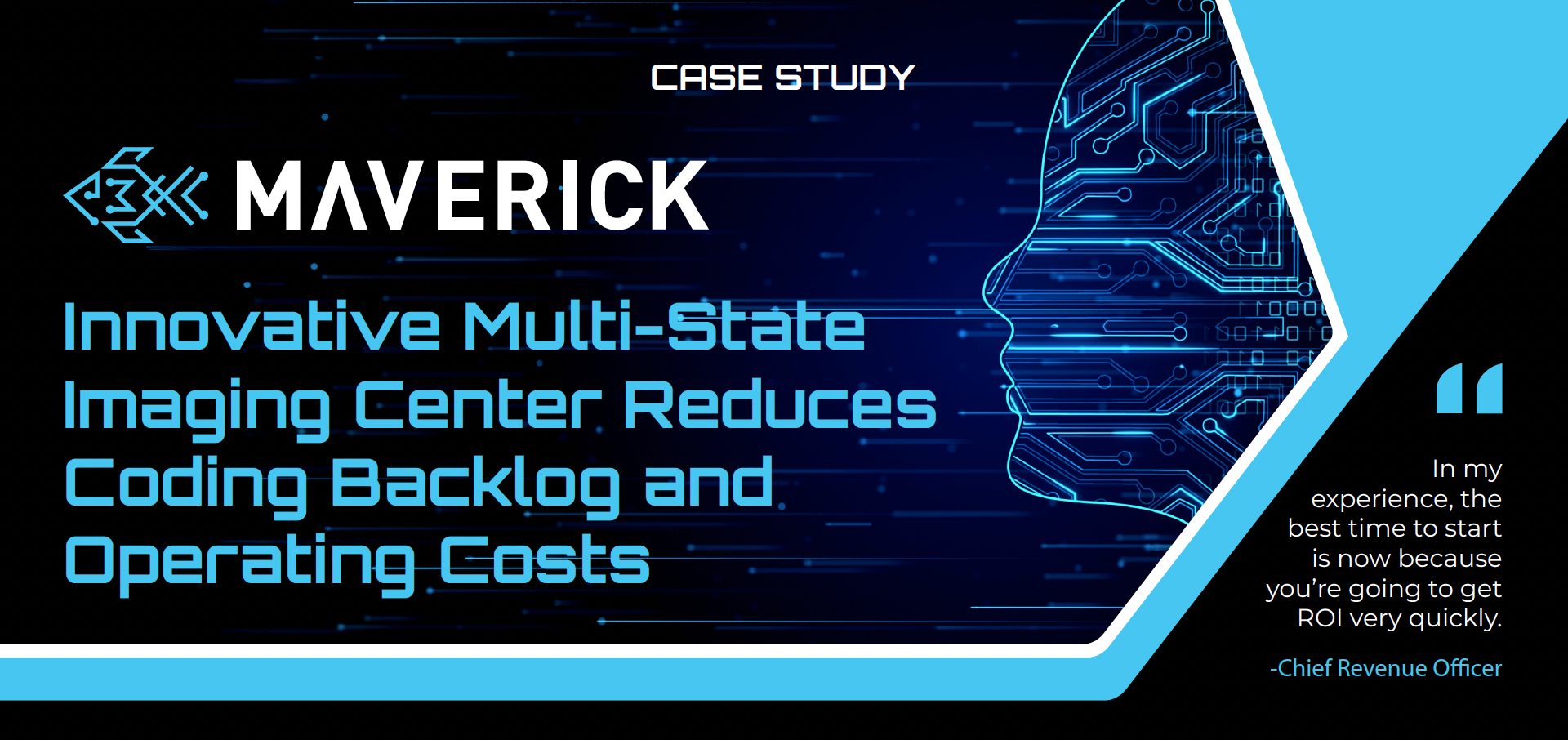
At Maverick Medical AI, we believe healthcare providers should spend more time focusing on patients—not paperwork. That’s why we built an autonomous medical coding platform that’s changing the game for imaging centers and hospitals alike. But don’t just take our word for it—here’s what happened when one nationally recognized imaging network partnered with Maverick.
The Challenge
This multi-state imaging network operates across 60+ sites, processing over 1.2 million studies annually. Like many healthcare organizations, they were facing rising costs, inconsistent coding accuracy, and a growing backlog that made it harder to scale.
The Results with Maverick
Once they implemented Maverick’s autonomous coding solution, the transformation was immediate:
- 87% Direct-to-Bill Rate – Nearly 9 out of 10 cases were coded entirely without human intervention—cutting coding time down to just seconds.
- 60% Cost Savings – With automation taking the lead, they were able to redeploy 6 of their 7 coders to higher-value tasks.
- 95% Coding Accuracy – By reducing errors, they slashed denial rates to just 3%, ensuring reliable and predictable reimbursement.
- Zero Backlogs – Coding lag time for direct-to-bill cases dropped to under 2 minutes, giving the team the scalability they needed to grow without operational strain.
Seamless, Scalable, Smart
Whether you’re a high-volume imaging center or a hospital navigating complex billing workflows, Maverick’s AI-powered platform integrates effortlessly with systems like Imagine, enabling:
- Real-time autonomous coding
- Customizable workflows
- Expert implementation support
All designed to help your team code faster, smarter, and with greater confidence.
Download the full case study here.
How Artificial Intelligence can reshape medical coding and optimize healthcare revenue cycle management

AI in Medical Coding: Navigating the Crossroads of Innovation and Anxiety
Having worked in the healthcare industry for over 30 years, I’ve witnessed many significant advances in technology, and while many have instantly been well received, the mention of any type of coding automation often strikes fear into the hearts of many medical coders.
There are many myths surrounding the use of AI in medical coding, but perhaps one that causes the most anxiety is the belief the adoption of AI in medical coding will lead to massive layoffs of medical coders. This myth is rooted in the assumption that AI systems will fully automate the coding process, eliminating the need for human coders. Let’s delve into why this fear is more fiction than fact, and explore the actual impact of AI on the medical coding profession.
Staffing Challenges
Twenty years ago, medical coders were fearful computer assisted coding (CAC) applications would replace them, reducing the number of medical coding jobs, but in fact the opposite occurred. The demand for medical coders has only grown in subsequent years, and currently there is a reported 30% shortage of medical coding professionals in the healthcare industry. Additionally, nearly 25% of medical coders in hospital settings currently pose a significant retirement risk.
FACT: Many organizations are dealing with staffing challenges ranging from keeping up with increases in volume, employees unexpectedly on extended medical leave creating backlogs resulting in need for outsourcing, as well as seeking solutions to handle attrition (retirement, resignation or death) given the difficulty in recruiting and retaining qualified staff.
Offshoring & Cost Savings
The most substantial negative impact to medical coding jobs in the US over the past two decades was not due to the introduction of CAC technology, but rather overseas outsourcing which still occurs on a regular basis. Too often, on LinkedIn I see a post from one of my thousands of connections sharing they were just given notice their position was eliminated due to offshoring. Unfortunately overseas outsourcing has become a necessity as the cost of delivering healthcare continues to rise while reimbursements have remained stagnant or in some cases have even declined. Offshoring is one of the easiest ways to reduce administrative costs.
FACT: Due to the cost savings realized through the many benefits of an autonomous medical coding solution the implementation of autonomous medical coding has the potential to significantly reduce offshoring and even eliminate it altogether for some organizations, keeping more medical coding jobs in the US.
The Perfect Duo: Humans & Machines
Autonomous coding solutions shouldn’t be viewed as a threat to medical coders, but rather viewed as the next generation of coding tools in a coder’s toolbox. The use of AI can boost coder productivity by significantly reducing the number of repetitive coding tasks and it can also boost accuracy by alerting the coder to potential issues that may otherwise go undetected. AI can supplement a coder’s expertise assisting them in making more informed and accurate coding decisions. Additionally, while many AI solutions demonstrate excellent accuracy rates for coding that is redundant with little variation, it can be challenged with coding more complex cases that require a degree of human reasoning and intuition which is an integral part of medical coding.
FACT: Realizing the maximum benefit from autonomous medical coding can only be achieved through a collaborative synergy by combining the efficiency of technology with the irreplaceable human touch.
Elevated Professional Status
While the role of medical coders will evolve over the next several years, it will certainly not be diminished. While traditional job roles are being reinvented, new job roles are also being created.
As autonomous coding technology gains more widespread adoption, a typical production coder can expect to transition into the role of an auditor, validating the output of an autonomous coding platform. Additionally, coders may be re-deployed to assist with other tasks or promoted to other revenue cycle roles including revenue integrity analyst or clinical documentation improvement specialists, where coding knowledge is invaluable.
Furthermore, companies who have developed autonomous medical coding platforms are currently seeking coding professionals with subject matter expertise to assist in product development and coding quality validation. Human subject matter expertise is vital to machine learning ensuring the coding model is initially trained correctly and properly maintained with coding updates.
FACT: The medical coding field stands poised to gain heightened professional recognition amid this transition. The critical role of human oversight in maintaining quality assurance highlights the pivotal position of medical coders as guardians of medical coding integrity. Medical coders have the opportunity to enhance their professional status by taking on more complex and advisory responsibilities.

Preparation Meets Opportunity
For medical coders, the path forward involves embracing change through continuous learning and skill set expansion as well as exploring non-traditional roles that benefit from coding knowledge and expertise, as well as managerial and executive roles.
Most importantly, medical coders should develop a career map outlining goals and the steps needed to achieve them, helping to navigate different stages in their career. While there are many aspects that should be considered when developing a career map, two of the most important are a skill gap analysis and a professional development plan. A skill gap analysis involves comparing your current skills with the skills required for the roles you aim to achieve in the future. Identifying gaps will then help you assemble a professional development plan outlining the steps you need to take to develop the necessary skills and qualifications to meet your career goals. These steps may include formal education, online courses, workshops, conferences, on-the-job training, networking, or mentorship opportunities.
FACT: For now, the immediate landscape for medical coders will remain relatively unchanged as AI technology is still evolving and has not yet been widely implemented and the shift to automation will occur gradually over time. In the healthcare industry, the adoption of new technology tends to be slow, often due to competing priorities and budgetary constraints. Additionally, while larger providers are typically the most likely to implement new technologies, mid-size and smaller providers tend to lag behind.
In the short term, medical coders should learn all they can about artificial intelligence – how it all works and how AI will impact the healthcare industry. Additionally, medical coders may want to consider learning more complex specialties and earning additional specialty certifications to boost their resume.
Learn more about Maverick’s Autonomous Medical Coding platform.
Revolutionizing the Revenue Cycle: The Benefits and Challenges of Autonomous Medical Coding

In the rapidly evolving world of healthcare, the implementation of autonomous medical coding systems presents a paradigm shift, boasting numerous benefits that will reshape the healthcare revenue cycle; however, it’s important to offer a balanced perspective on its role and also explore some of the challenges that come with this technology.
First let’s take a look at a few benefits of implementing an autonomous medical coding platform.
Benefits
Scalability. Perhaps one of the greatest benefits is scalability which enables providers to handle increases in volume without adding additional staff. This aids in preventing backlogs that can occur with large increases in volume, and eliminates the need for securing outsource coding support or hiring of additional staff.
Increased Efficiency & Productivity. Autonomous medical coding systems allow more records to be coded in less time as the coding platform is able to handle redundant coding that does not require review by human coders, allowing coders more time to focus on complex cases, boosting overall coding productivity. Autonomous medical coding is not intended to replace medical coders but to enhance their work by improving efficiency and accuracy.
Cost Savings. Implementation of an autonomous medical coding solution can lead to lower operational costs. The aforementioned benefits – scalability, increased efficiency and productivity – result in cost savings allowing providers to do more with fewer resources.
Consistency and Enhanced Accuracy. It is not uncommon for a single group of medical coders to exhibit variations in the diagnosis codes they assign for the same documented services, resulting in inconsistency of how the same cases are coded. This may occur due to different levels of training and expertise and/or differing interpretations of coding guidelines among the coders. Automation can provide uniformity in coding that cannot be achieved among a team of human coders and reduce human errors.
Reduced Denials. An autonomous coding solution can assist in reducing common errors that lead to denials. Through automation, potential errors can be identified and flagged prior to coding being finalized allowing for correction prior to claims submission. Additionally, these systems can be tailored to meet the specific requirements of different third party payers, addressing their unique coding preferences or guidelines and thereby reducing denial rates.
Compliance & Quality Assurance. Autonomous medical coding platforms can have a positive impact by improving accuracy and consistency in coding by reducing human errors, such as data entry mistakes or misinterpretation of coding guidelines. Additionally, they can provide real-time auditing and feedback, identifying potential errors or inconsistencies as they occur, allowing corrective action to be taken. This immediate correction helps maintain high-quality standards and compliance. Furthermore, these systems can be tailored to meet specific compliance requirements of different healthcare providers or insurers, ensuring that coding meets all necessary guidelines reducing the risk of non-compliance.
Now that we have covered some of the benefits, let’s focus on some challenges inherent in the technology.
Challenges
As with any new and emerging technology, the adoption of autonomous coding brings numerous advantages, but it also requires careful consideration of potential challenges, many of which can be effectively addressed during a robust implementation phase including the coding validation process. Additionally, ongoing auditing and monitoring post-go live enhances these efforts.
Lack of Human Intuition. Medical coding is very nuanced and there is a degree of human reasoning that comes into play when assigning diagnosis codes, in particular with procedures and services that are not quite as straightforward and have lots of variation in applicable codes that can be assigned. Algorithms do not possess this level of reasoning as machines learn from patterns attached to data; however, Maverick’s Autonomous Medical Coding platform learns from complex examples coded by humans, equipping it with the ability to code more complex cases over time.
Training Data Bias. Training data bias in autonomous medical coding refers to situations where the data used to train an AI system for coding medical records is not fully representative of real-world scenarios. This bias can occur if the training data is too limited, contains errors, or over-represents certain types of cases while under-representing others. If the training data is biased, the coding decisions made by the coding platform might be incorrect or biased. Maverick has developed a unique technology based on Generative AI to automatically identify these incorrect/biased data and replace them with correct synthetic data that is automatically generated improving the data quality.
AI Hallucinations. There may be instances when unexpected outputs are generated which may not be relevant or accurate. These outputs are referred to as hallucinations. This term refers to occurrences when AI generates unexpected outputs, which may not be relevant or accurate. This can happen for various reasons, including limitations in the AI’s training data, algorithms that misinterpret patterns, or the AI filling in gaps with incorrect or nonsensical information.
Data Quality. Since machine learning and deep learning are based on historical coding and documentation patterns, the integrity of historical data is of the utmost importance. If the historical data contains errors, the coding engine may replicate these mistakes leading to incorrect coding. Without quality historical data, the risk of errors and biases increase, therefore it is important to regularly perform coding audits prior to implementation to identify any potential coding and documentation issues and implement corrective action prior to go-live.
Over Documentation & Medical Necessity. As with any technology there is always a risk of providers over-documenting services in a way that maximizes reimbursement rather than accurately reflecting only medically necessary care. It is important for providers to monitor physician documentation practices to ensure that providers aren’t documenting solely for the sake of getting paid additional dollars.
Compliance & Quality Assurance. While on one hand, autonomous medical coding solutions can assist in improving compliance, at the same time these systems require ongoing monitoring and human oversight to ensure they remain compliant and maintain high rates of accuracy. Remember, if the model is trained on incomplete, outdated or biased data, the output may not be correct or if an error is embedded during the learning process, it can be propagated across many cases before being identified resulting in inaccuracies and coding compliance issues. It is important not to become overly reliant with the technology removing the human factor altogether.
Summary
Autonomous medical coding systems are positioned to revolutionize the healthcare revenue cycle with their scalability, efficiency, cost-effectiveness, and improved accuracy, all of which are pivotal in today’s fast-paced medical environment. However, it’s crucial to remain aware of the challenges inherent in the technology, all of which can be mitigated before, during and even after the implementation phase. Success requires human oversight and continuous improvement of processes.
It’s important to strike a balance between leveraging these advanced tools for their immense benefits while also proactively addressing the challenges. Maverick’s implementation approach is designed to identify and overcome many of these hurdles prior to go-live, allowing rapid implementation and scalability to its customers.
It is necessary to acknowledge that not all autonomous medical coding systems are created equal and platforms may differ significantly in their capabilities; therefore selecting the appropriate system is not merely important—it’s crucial. As AI solutions are rapidly progressing with advancements in transformer technology and Large Language Models (LLMs), Maverick continues to leverage the use of Generative AI in their coding engine, resulting in better rates of automation with higher accuracy, surpassing the 85% Direct-to-Bill threshold.
Radiological Society of N. America – Our Takeaways

RSNA 2023 was a standout event, showcasing pivotal insights into current trends and challenges in radiology. A recurrent theme among attendees was the pressing need to address staffing challenges in healthcare and the evolving role of Artificial Intelligence (AI) as a potential solution.
The conference highlighted the multifaceted nature of these staffing challenges, emphasizing the increasing demand for skilled administrative personnel. It brought to the forefront the critical role of technology in enhancing operational efficiency to mitigate these shortages.
A key insight from RSNA was the growing recognition and value of AI in both clinical and administrative healthcare realms. In clinical settings, AI’s role in image analysis is proving invaluable, offering faster and more accurate diagnoses, thereby improving patient outcomes and reducing the burden on radiologists. Administratively, AI is revolutionizing processes, from patient scheduling to revenue cycle management, leading to more streamlined healthcare services.
Another crucial observation emerging from RSNA is that AI technologies are not uniform in their application or effectiveness. For healthcare providers, this underscores the importance of choosing AI tools that are best suited for specific tasks and contexts. This necessitates a deep understanding of the diverse capabilities and limitations of various AI technologies. The focus of RSNA on these considerations reflects a commitment to a thoughtful and effective integration of AI in healthcare, harmonizing technological advancements with the expertise and needs of healthcare professionals.
As an experienced healthcare professional, I am thrilled about the transformative journey AI technology is embarking upon across the diverse sectors of healthcare. The anticipation of how AI will reshape healthcare is exhilarating. This innovation is revolutionizing how revenue cycle management is practiced today to create more efficient, effective systems. The possibilities are endless, and I am immensely excited to be part of this era in healthcare.
Charting the Course: Best Practices for Implementation of an Autonomous Medical Coding Solution

In today’s rapidly advancing digital world, autonomous medical coding solutions are changing the landscape of the healthcare revenue cycle. It isn’t a matter of if autonomous coding will gain widespread adoption, but rather a matter of when, particularly if your organization performs a large volume of procedures.
During a recent presentation, members of the audience were asked about their timeframe for implementing an autonomous coding solution. 76% of the audience was twelve months or more out from implementation. This group is in a perfect position to take some necessary steps to ensure a highly successful go-live experience with a high direct to bill percentage. Regardless of your timeline for implementing a solution, it’s never too early to begin planning.
Because autonomous coding solutions are unique from computer assisted coding (CAC) in being trained on historical data, a highly successful roll out is dependent upon the quality and accuracy of information provided to train the model. To achieve the highest direct-to-bill rate possible at go-live there are three main areas that should be addressed.
Documentation Improvement
It’s no secret that the number one key to correct coding and reimbursement is complete and accurate documentation. While the autonomous coding models are more forgiving with documentation than CAC, models still cannot code what is not documented in the report. The more robust the documentation, the better the output.
To see to it that all applicable codes will be assigned accurately, it is important to review all radiology report templates to ensure all required elements for coding and billing can be captured in the final radiology report.
CPT & HCPCS Coding
Key items that should be in each template to ensure correct CPT & HCPCS coding:
- A clear, concise exam title;
- Detailed technique/parameters for the test being performed (ie, number and types of views, without and/or with contrast, etc.);
- Documentation of all supplies utilized (ie, contrast materials, radiopharmaceuticals, etc.);
- Supporting documentation for all selected quality measures.
ICD-10-CM Coding
The assignment of accurate diagnosis codes presents its own unique challenges when it comes to documentation. Emphasis should be placed on clear and comprehensive documentation of both the presenting clinical indications and the impression specified by the radiologist to ensure correct ICD-10-CM coding.
The ICD-10-CM Official Coding Guidelines for Outpatient Reporting require that encounters are coded to the highest level of specificity. This information is typically found in the impression. When there are findings in the impression that are related to the reason for the exam, this condition should be coded as the first listed (primary) diagnosis for the encounter. If the impression is normal, correct code assignment is based on the presenting clinical indications noted in the reason for exam or history fields.
Some radiologists will state in the impression “see findings”, but often there are findings listed that are considered incidental or not clinically relevant to the reason for the test. It is a best practice for the radiologist to prioritize findings in the impression section of the radiology report.
In general, it is recommended for radiologists to follow the ACR Practice Guideline for Communication of Diagnostic Imaging Findings for final reports. Following these guidelines ensures all required elements for coding and billing will be documented in the report.
Workflow
Implementation of an autonomous coding solution is a great opportunity to improve your current workflow affecting coding compliance.
In addition to the radiology report, the medical record is composed of other documents often stored in the radiology information system (RIS) including diagnostic test orders, patient questionnaires and technologist worksheets. While these items are all part of the patient medical record, it is a best practice for all key elements needed for complete coding to flow into the final radiology report itself.
In particular, it is important to note that Center for Medicare & Medicaid Services (CMS) charges the referring (ordering) physician with documenting medical necessity for any diagnostic tests that are ordered. This information is communicated via the diagnostic test order. The reason for the test provided by the ordering physician should be entered into a predefined field in the RIS to auto-populate the radiology report. While additional information can be taken from the patient and added to the report, it should not be considered as the primary source for ICD-10-CM coding.
Regardless of your coding process or workflow, when information needed for coding is not contained in the radiology report (indications supporting medical necessity, supplies, exam parameters, etc.) this is very disruptive to the coding workflow, as the coder must go searching for this information in the RIS, or place the encounter on hold for someone else to research, slowing down the coding process, resulting in decreased productivity.
Furthermore, if this has been and continues to be an ongoing problem, this will affect the performance of the model because it cannot learn to code accurately what is not documented in the radiology report. Additionally, if this problem persists after go-live, the model will not be able to code these encounters, they will be routed to the coders for review and the model misses the opportunity to learn from the final code assignments.
Coding Quality
Since the model initially learns to code from historical data, achieving a high direct-to-bil percentage at go-live is heavily dependent upon the quality and accuracy of historical coding and documentation.
Proactive steps to ensure coding quality include:
- Perform coding audits on a regularly scheduled basis, either monthly or quarterly. While coding audits may be done internally, it is prudent to periodically hire an external auditor for a fresh perspective to determine if there are any areas of concern that may have been missed through the internal auditing process. It is imperative to identify any potential coding and compliance issues and implement corrective action prior to go-live
- Implement written coding directives to limit subjectivity and promote coding consistency among members of your coding team. This will minimize variations in how certain encounters are coded and this information will help your chosen vendor in guiding the model to perform to your specific expectations. Additionally, this information is helpful after go-live to ensure that any edits made to coding engine output are made in the same manner by each coder so as not to confuse the model.
- Provide coder education on a regular basis. This will ensure high rates of accuracy and consistency are maintained.
Taking these proactive steps ensures the model is trained with the most up-to-date coding guidelines for your organization.
Conclusion
By focusing on comprehensive documentation improvement, refining CPT & HCPCS and ICD-10-CM coding practices, optimizing workflow, and placing a magnifying glass on coding quality, providers lay the groundwork for an autonomous coding solution that’s both effective and efficient. Regular audits, ongoing education, and a commitment to consistent quality assurance will ensure the highest direct-to-bill rates and an autonomous coding solution that is trained on the very best historical data.
Broadcast – Generative AI meets Medical Coding

Join us for a broadcast with CHCS Consulting, featuring Brad Adams, VP Sales and Stacie Buck, Director of Coding Compliance as we explore Generative Artificial Intelligence in Medical Coding. Discover how this technology is not only reshaping the landscape of revenue cycle management but also enhancing the accuracy and efficiency of the medical coding practices. Don’t miss out on the opportunity to uncover transformative insights that AI is making in the healthcare industry.
Decoding the Future: Understanding the Differences Between CAC & Autonomous Coding
It’s nearly impossible to turn on or read the news without hearing a story about artificial intelligence (AI). While it seems like it’s a completely new technology, in fact, we have been co-existing with bots for many years through the use of automated systems, interacting with chat bots when contacting customer service departments, and of course, with some of the most well known AI personalities, Siri & Alexa.
AI technology is reshaping the landscape of many industries, and it’s poised to have a significant impact on the healthcare industry. AI solutions are already being deployed throughout many areas of the revenue cycle – patient scheduling and registration, eligibility verification, charge capture, claims & denial management, payment collection, patient communication and of course medical billing and coding.
Over the past two decades, much of the medical coding has been performed using Computer Assisted Coding (CAC) technology. CAC is an early form of AI primarily utilizing natural language processing (NLP) to assign CPT, ICD-10-CM & HCPCS codes to encounters. While the use of CAC has continued to grow since its inception, autonomous coding solutions are now positioned to replace CAC technology.
In speaking with coding professionals across the country, I have noted that often autonomous coding is thought of as the next version of CAC, when in fact, the technology is very different from CAC in its design and functionality.
Let’s take a look at only a few key differences between CAC and autonomous coding.
1. CAC is a tool that relies heavily on human intervention to arrive at correct codes, while autonomous coding solutions can code many encounters in seconds with no human intervention
2. CAC requires reports with a predefined structure and cannot easily adapt to changes in language patterns. AI can process reports with unstructured data and can detect language patterns and consider context.
3. CAC is primarily driven by NLP, focusing on the identification of specific words and phrases to suggest codes, while relying heavily on rule-based coding. Autonomous coding solutions utilize machine learning, deep learning and algorithms to assign codes.
Machine learning is a process in which computers learn from data without being explicitly programmed. Deep learning takes this process a step further using multiple layers to recognize complex patterns in data. Deep learning models are taught using a large historical data set to train algorithms to ensure the coding engine produces the most relevant predictions, capturing the subtle variations and coding style of the provider. This process of using large amounts of historical data is what makes achieving a high direct-to-bill percentage possible.
4. In a typical CAC workflow, reports are sent to the coding engine, the engine reads the text and provides code suggestions. A coder then reviews the coding engine output and makes any necessary changes. If a repetitive error is noted, a rule may be created to correct the issue. This can be a time consuming process, resulting in hundreds and even thousands of rules being established over a course of time. With an autonomous coding solution, reports are sent to the coding engine, coded within seconds and sent directly to billing. Any encounters that cannot be coded by the engine, will be sent to a human coder for review. As coders modify an assigned code or add or delete codes, the model is trained and re-trained in real-time each time a coder makes these changes.
Conclusion
While traditional CAC workflows still require considerable manual intervention and rule-setting, autonomous coding solutions stand out with their real-time learning capabilities. Not only do they streamline the coding process, but they also continuously refine their accuracy with each human intervention. The convergence of technology and human expertise in this domain signifies a promising step towards more accurate and efficient coding in the future.
Unlocking Success with Matan Neeman: Implementing an Autonomous Medical Coding Solution for a Frictionless Go-Live

Maverick Medical AI is supported by an entire team of industry veterans of medical, regulatory, and AI/ML experts that not only had the vision to revolutionize medical coding, but are further revolutionizing the implementation phase with well defined, frictionless stages. VP of Product, Matan Neeman, shared some details about implementation when you’re making the transition to autonomous medical coding with Maverick.
Q: Matan — tell us a bit about yourself. What is your role with Maverick Medical AI?
 I joined Maverick in early 2022 with a mission: To use machine learning and Generative AI technologies to automate the medical coding world. I spent my career in digital health, with a focus on information systems that support healthcare practitioners – technicians, physicians, nurses and administrators. I was part of a group who developed Cardiology PACS and Information Systems, then moved to the Radiology and Advanced Visualization space, and supported implementations of Enterprise software systems across multiple healthcare networks and systems.
As the leader of the product team at Maverick, I’m responsible for an important piece of our offerings: Product Management, skilled project management, implementation, training, and quality monitoring. Many vendors in this space leverage implementation specialists, and perhaps billing specialists, but Maverick leverages an entire team of product, project, implementation, revenue cycle experts, and beyond – all with in-depth medical and coding expertise. Folks who’ve been in the trenches and have an immensely in-depth understanding of the clinical environment.
The critical understanding and background our team has, paired with the way we collaboratively work with clients to implement autonomous medical coding to their practices and systems, differentiate Maverick.
Q: Tell us about Maverick’s implementation process – how do you ensure a frictionless experience?
Our team devised a meticulous process to minimize client implementation hours while validating historical data quality. Once we comprehend the implementation’s nature, such as shifting from less automated to more automated systems or from no automation to autonomous coding, we create a customized project plan. This planning stage is integral, offering change management assistance, identifying impacts on team members, stakeholders, systems, and processes, all for a seamless transition.
The key part of our implementation strategy that makes go-live frictionless? It’s a simple philosophy, but it’s critical: Preparing for it in advance. We engage organizations with a consultative and collaborative approach, leveraging their expertise, and yielding a plan that’s specifically for them and yields a much better outcome.
Collaboration with customers during the setup stage is critical to achieving the 85% direct-to-bill rate. We both have responsibilities that ensure the success of the implementation. One of these critical pieces to work and collect stakeholder input and analyze historical data to train the Maverick autonomous medical engine. Many vendors start at zero and add rules and automation after. Additionally, practices who’ve extensively customized their existing products may face challenges transferring this knowledge to a new system due to the lengthy accumulation of customizations by various individuals, many of whom are no longer with the organization. Unlike other vendors, Maverick eliminates the need for customers to manually provide these rules and customizations. Instead, Maverick automatically extracts this information from historical data, enabling a smooth and efficient transition. It’s beneficial and a lot less burdensome to our clients, especially in a replacement market where old tech has already become a burden.
Q: What else can a customer expect at go-live? Why should folks look no further than Maverick for autonomous medical coding?
Customers can expect the same degree of planning and careful monitoring to happen after go-live as they experienced beforehand. Our depth of knowledge in coding and not just implementation is key. Our folks have a greater understanding of the clinical environment and are adept at problem solving in a way that won’t frustrate clients who rely on folks who are only familiar with billing and implementation. Our decades of coding experience sets us apart. We relate to everyone, from SME to the clinical user to management and our resources pull from every department imaginable – all to serve our customers better without the unnecessary burden.
I encourage anyone who is interested in autonomous coding for their practice or health system to request a demo and learn about the advantages of a frictionless implementation of Maverick’s autonomous coding solution and how you can experience an 85%+ direct-to-bill rate.
Unleashing the Power of Artificial Intelligence in Medical Coding

Embark on a fascinating exploration at the cutting-edge intersection of Artificial Intelligence and medical coding, guided by Contempo Coding – Victoria Moll. Joining her are our visionary CEO and Founder, Yossi Shahak and our nationally recognized subject matter expert (SME) in medical coding, Stacie Buck. Together, they delve into how AI is catalyzing a revolution in medical coding methodologies, streamlining reimbursement and enhancing accuracy in this captivating video.
See how Maverick’s Autonomous Medical Coding solution can impact your practice.
Unraveling the Depths of AI Deep Learning: Decoding the Essence of Autonomous Coding

In the face of medical coder shortages and burnout, Maverick Medical AI is dedicated to revolutionizing the healthcare industry. Research highlights a projected 7% annual growth in demand for medical coders, while a current 30% workforce shortage exacerbates the challenges faced. These shortages have far-reaching negative consequences, including increased claim denials, revenue delays, and inaccurate coding practices.
To tackle these administrative burdens, the implementation of AI-driven solutions presents an exciting opportunity. While many Healthcare Executives recognize the potential of AI, it is crucial to acknowledge that not all autonomous medical coding solutions are created equal in terms of accuracy and performance.
In the early days of medical coding, the process heavily relied on manual intervention and expertise. As technology advanced, rule-based systems emerged as a solution to automate certain aspects of coding. These systems utilized predefined rules and algorithms, aiming to streamline the coding process. However, they had limitations, including the need for extensive manual rule development and a lack of adaptability to handle complex and evolving coding scenarios.
The introduction of machine learning algorithms brought a significant shift in medical coding technology. These algorithms leveraged data to learn patterns and relationships, allowing for more automated and accurate coding. Nevertheless, human experts were still required to manually extract relevant data for these machine learning models.
At Maverick Medical AI, our cutting-edge technology harnesses the power of clinical language models, deep learning techniques such as Generative AI, and Generative Pre-trained Transformers (GPT). These advancements enable accurate and efficient coding of unstructured text, exceeding a remarkable 85% direct-to-bill rate and an exceptional accuracy rate of 97% upon implementation. Our commitment to pushing the boundaries of innovation sets us apart in the market.
How do we accomplish this?
Let’s shed a light on our remarkable technology stack.
Ensemble Architecture
By employing an ensemble architecture, we merge numerous models, specifically deep learning AI networks proficient in discerning patterns and excelling at various tasks, along with other algorithms. This approach harnesses the strengths of diverse models with the objective of enhancing the overall performance and adaptability of the system. Medical Coding is ideal for this architecture, where it can truly excel in accomplishing these tasks.
Language Models
Developing a medical coding language model required a significant amount of effort to tune and adapt existing toolkits, incorporating our medical coding expertise and specialized models specific to the task. This has allowed us to customize, adjust, and enhance the technology according to our unique coding expertise.
Other language models cannot do this. ChatGPT, for instance, does not inherently solve the problem at hand. While ChatGPT is a powerful language model, it is not a medical coding platform. It has limited ability to generate accurate medical codes as it may not have the most current coding information nor does it understand the nuances of the practices, payors, and regulations. What point would there be to using ChatGPT in its current form for the purposes of medical coding, when the goal is to increase accuracy and reduce reliance on human coders in short supply and such high demand? The degree of auditing necessary would actually become an increased burden to coders.
Coding Accuracy
Maverick’s autonomous medical coding AI engine is trained on a vast dataset of medical codes, enabling it to comprehend the intricate and dynamic rules and regulations governing our industry.
For effective machine learning, a substantial volume of consistent, accurate, and up-to-date data is required to train the system. Even the most exceptional providers with well-established workflows and practices may face challenges in maintaining data consistency and keeping it updated with the latest regulations over time.
The Maverick algorithm uses various sampling testing and techniques in machine learning to ensure that we are able to train the model with minimal human interaction and to iteratively improve it.
Understanding the provider’s historical data has been the success of Maverick’s achievement of 85% direct-to-bill rate at go-live.
As we all know, garbage in is garbage out. During implementation, large amounts of claims data, along with the reports, are analyzed and validated. Any coding quality issues are identified and corrected prior to go-live. And learning from historical data means no countless hours spent starting from scratch to rebuild coding rules.
Breaking the coding barrier
Maverick employs advanced techniques to address scenarios with limited data. One such approach is the utilization of Generative AI models, which enable the generation of synthetic data resembling real-world examples. This synthetic data creation process allows Maverick to augment the available data and continuously enhance the system’s performance.
Additionally, Maverick utilizes transfer learning, a technique that leverages knowledge gained from pre-trained models on related tasks. By fine-tuning the pre-trained models using specific medical coding data, Maverick ensures consistent training and further refines the system’s accuracy in assigning appropriate codes.
By combining Generative AI for synthetic data generation and transfer learning for fine-tuning, Maverick optimizes the performance of its medical coding system, even in scenarios with limited data. This groundbreaking approach empowers Maverick to attain exceptional coding accuracy, enhances the overall efficiency of medical coding processes, and is the key factor behind our ability to achieve a guaranteed direct-to-bill rate of 85% upon go-live.
Maverick is leading the market!!!
Maverick is continuously setting new benchmarks in accuracy, adaptability, and efficiency in the realm of medical coding. Our advanced solutions not only yield highly precise codes, surpassing 97% accuracy, but also fulfill the rigorous requirements of payors and regulatory agencies. With a guaranteed 85% direct-to-bill rate upon go-live, Maverick is redefining industry standards today and for the foreseeable future.
AI Autonomous Medical Coding: A Coder’s Perspective
Many years ago, the company I worked for was an early adopter of Computer Assisted Coding (CAC) technology. At that time the vendor was claiming up to 75% of coded reports could be sent direct-to-bill and for a billing company, that claim was very promising. Unfortunately 3 years after implementation we were still reviewing 100% of the CAC coding output and never sent any claims direct-to-bill because we did not have confidence in the accuracy of the coding engine.
Fast forward two decades later, while there have been many improvements with CAC technology it still has not achieved high direct-to-bill rates once promised. It has limited capabilities using natural language processing (NLP) and relying on rules based coding. From my observations working with many providers across the country, CAC rarely exceeds a 50% direct-to-bill rate and many providers are not even hitting that threshold. Unfortunately, CAC has fallen short on desired outcomes for a large number of providers. Thankfully with the evolution of technology, artificial intelligence now has the ability to deliver better coding outcomes with a solution such as Maverick Medical AI’s autonomous coding solution.
When I initially began working with Maverick, they boasted of an 85% direct-to-bill rate at go-live. The skeptic in me said ‘No way, that threshold just isn’t possible.’ Much to my surprise Maverick has been able to deliver on that claim and I am excited to see how their technology will revolutionize the medical coding industry.
One of the main reasons why Maverick’s autonomous coding solution can deliver better outcomes than CAC is because it is powered by AI deep learning technology, rather than rules based coding. As a human coder interacts with the coding platform and makes coding changes, the platform is learning based on those changes and over the course of time the engine gets better and better at predicting codes. The success of Maverick in achieving an 85% direct-to-bill rate is largely due to applying the deep learning technology to a provider’s historical data.
Switching to a new coding solution may seem overwhelming and time-consuming, but the implementation process with Maverick is simplified. During the implementation phase, large amounts of claims data along with reports are processed and analyzed and then validated for coding accuracy. Maverick’s validation phase ensures that any coding quality issues are identified and corrected prior to go-live, reducing any future risks associated with coding quality. Much of this work is performed by Maverick’s coding experts, keeping the amount of time and resources allocated by clients during the implementation phase to a minimum. Additionally, there is no need to spend countless hours starting from scratch building your coding rules all over again since Maverick’s coding solution learns from your historical coding data.
As evidenced by the frenzy of new AI technology flooding the market, autonomous coding is the future of medical coding and CAC as we know it will become a thing of the past. With autonomous coding solutions becoming more prevalent in the market there are 3 key areas providers can address now to ensure the best outcomes with the autonomous coding solution of their choice:
1. Documentation improvement. Clear and concise documentation is the first key in achieving success with an autonomous coding solution. Coding is only as good as the documentation regardless of how coding is being performed. Utilizing standardized templates which contain all pertinent information to assign CPT, ICD-10-CM and quality codes are best.
2. Coding quality. Since a large component of the coding output is tied to historical coding practices, a provider should have confidence in its current coding quality. Providers should conduct regular coding audits (both internal and external) to validate coding integrity and correct any issues noted prior to implementing an automated solution.
3. Workflow. An efficient workflow is key to any successful implementation. It is essential to evaluate existing workflows and identify and resolve any issues that may be a barrier to implementation and proactively solve them before introducing any new coding solution.
Stacie L. Buck, RHIA, CCS-P, RCC, RCCIR, CIRCC
President & Senior Consultant, RadRx